
Ciciliani as performer
Ciciliani plays the electronics in most of his own work, and for long stretches he has been his own soloist as well. The concert listings show three overlapping phases: the no-input mixer until 2008, pieces with laser from 2008 into the mid-2010s, played first on the mixer and then on an analog synthesizer, and from 2011 a solo programme of audiovisual pieces with live video, projections, lighting and laser.
The no-input mixer
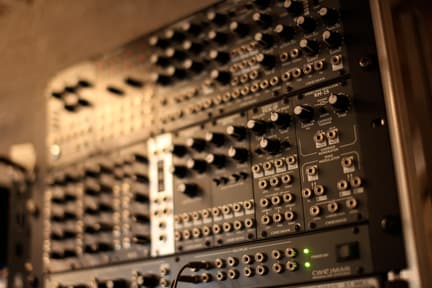
From 2000, for almost ten years, his main performance medium was the mixing board "sans instruments", played with nothing but the feedback of the machine itself. He built a reputation as a virtuoso of this abstruse practice. The no-input mixer is usually associated with minimal layering; his performances were densely textured instead, letting the cross-interference of feedback from the circuits grow into complex patterns.
On the mixer he played with Fred Frith, Gordon Mumma, Roberto Fabbriciani, Axel Dörner and Sachiko M, among others. The Dutch magazine Fake interviewed him about the instrument in June 2003. In March 2008 the Amsterdam label Evil Rabbit Records released his solo CD 81 matters in elemental order, and that record marked the end of his activity as a no-input mixer player.
Synthesizer and laser
The bridge to the audiovisual pieces was Corrosive, later called Corrosion: first for no-input mixer and laser, then for analog synthesizer and laser reflections. The autumn of 2008 took it from a symposium on the Istrian coast to Japan, with dates in Ogaki and Tokyo. In 2009 it went to Los Angeles, Ireland, Hamburg, Leipzig, Ljubljana, Maribor and Berlin. The last listed performance is from November 2015, in Opatija.
The audiovisual solo programme
From 2011 he worked on a new solo programme, a set of compositions for different combinations of electronics, projections, lighting and laser. The idea was to use the visuals as an extension of the performer, reflecting the performer's actions in the visual design so that it carries a strong sense of liveness. At the same time the images were meant to stand as an autonomous layer, in changing relations to the music and complementing it to different degrees.
The newest piece of that programme in 2015 was Via, premiered in March of that year, a piece that borrows from games: strict rules on one side, room for spontaneous decisions on the other. Tours in 2015 took the programme to São Paulo, Brasília, Singapore, Kuala Lumpur and Yogyakarta.
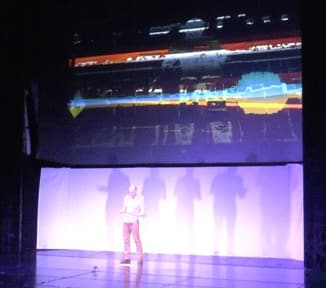
A typical evening in 2017, as played at the Austrian Cultural Forum in London, in Milan and at Kyung Hee University in Seoul, ran in this order:
- Via (2015), for live electronics, live video and lighting
- Atomic Etudes (2016), for Monome
- Pop Wall Alphabet (2011–15), for soundtracks and text video
- Points of Audition (2017), for fixed media
- Intersection (2013), for live electronics, live video and lighting
Duos and improvisation
Many evenings were duos with the violinist Barbara Lüneburg, with Ciciliani running electronics, lighting, laser and video for Alias, Formula minus One and Steina. Their joint programmes of 2013 to 2015 often added 8'66" for video and two tablets, which they played together, and Intersection.
Improvisation turns up now and then in the listings. In 1999 he played with Yannis Kyriakides, Lucio Capece and Yoshio Machida at Kraakgeluiden in Amsterdam, and in 2008 with Machida again at Super Deluxe in Tokyo. In April 2009 he joined Ulrich Krieger, Michael Fink and Antony Digennaro at REDCAT in Los Angeles, and in March 2013 Johannes Kretz and Franz Hautzinger at the Sammlung Essl in Klosterneuburg, where he played analog electronics and projections.